What is Fiber-to-the-Home (FTTH) Technology? A Simple Guide for Nigerian Homes
You are on a video call. The kids are streaming cartoons in the other room. Someone is trying to download a large file. Then everything slows down at once. Sound familiar? Most Nigerian homes deal with this every day. The frustrating part is: you are now used to it, and it doesn’t have to be that way.
A different type of internet technology is changing how Nigerian homes stay connected. It is called Fiber-to-the-Home, or FTTH. And it is the reason FiberOne customers can run five devices at once without a single buffer.
In this guide, we break down exactly what FTTH is, how it works, and why it is the future of internet in Nigeria, in plain language, no tech degree required.
What is Fiber-to-the-Home (FTTH)?
FTTH stands for Fiber-to-the-Home. It means a fiber optic cable runs directly from your internet provider’s network all the way into your home.
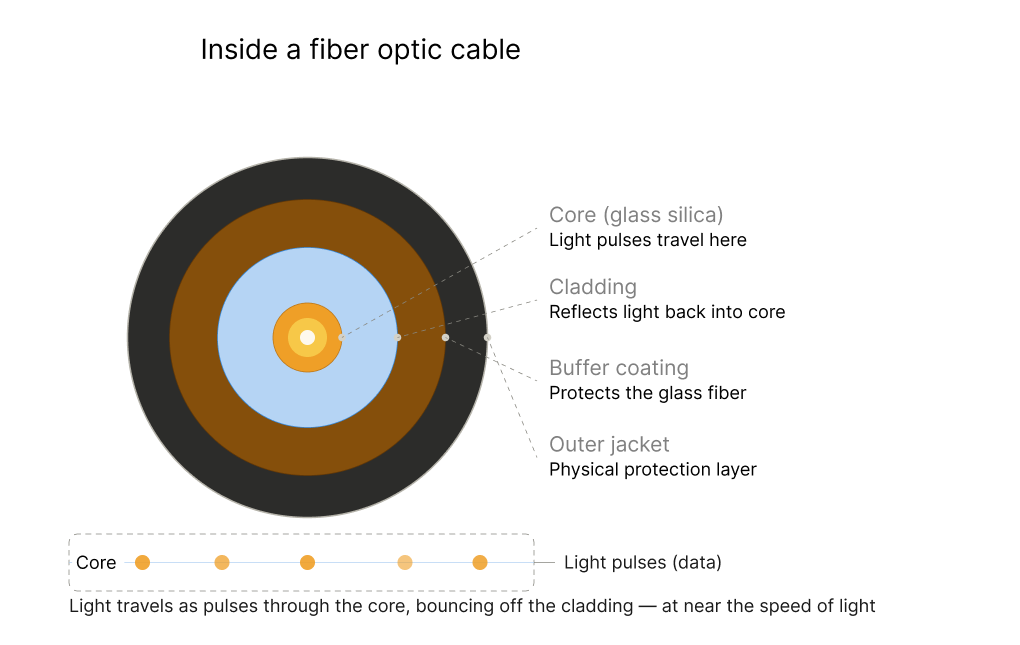
Fiber optic cables carry internet signals as pulses of light, not electrical signals, through copper wire like older broadband. Light travels fast and does not degrade over distance. And light can carry a lot more data.
The result? A faster, more stable, and more reliable internet connection. One that can handle your whole household at once.
Think of it like upgrading from a narrow, potholed road to a brand-new six-lane highway — built specifically for your home.
Not All Fiber Internet Is the Same?
Many internet providers in Nigeria advertise “fiber” broadband. But the type of fiber setup they use makes a big difference in the quality of your connection.
Here are the two common types:
Radio over Fiber (RoF or RFoF)
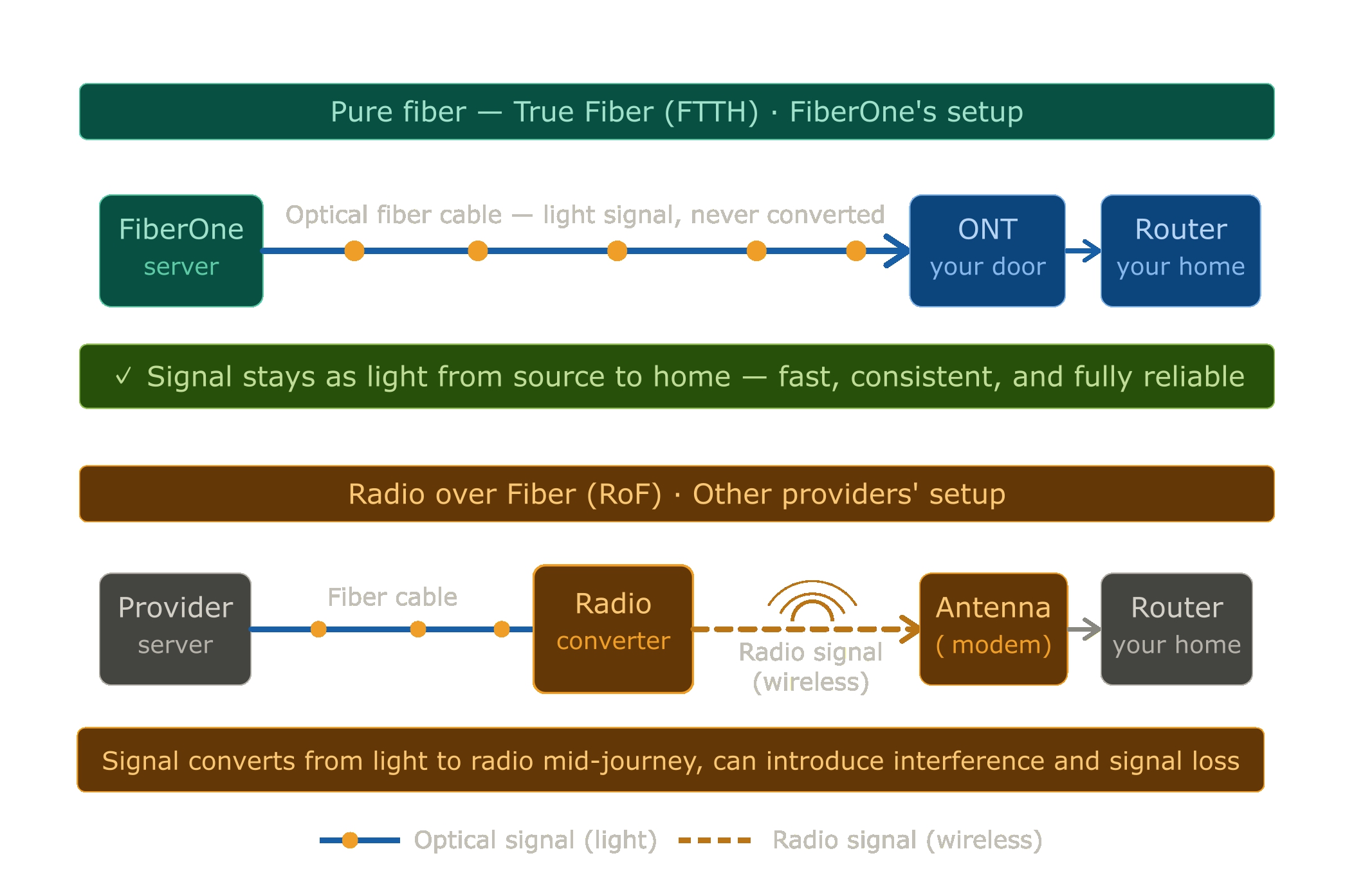
Some providers use a setup called Radio over Fiber. This means the signal starts as fiber, but at some point along the journey, it gets converted into a radio (wireless) signal to cover the last stretch to your home.
Think of it like a relay race. The baton starts strong, but every time it changes hands, there is a risk of it slowing down or dropping.
RoF can work but the radio portion introduces interference, signal loss, and inconsistency. Weather, physical obstacles, and network congestion can all affect it.
Pure Fiber — Also Called True Fiber (FTTH/FTTP)
Pure fiber, scientifically known as FTTH (Fiber-to-the-Home) or FTTP (Fiber-to-the-Premises) works differently. The signal stays in its original form: pure light. From FiberOne’s server all the way to your front door, the signal never gets converted into radio waves or electrical signals. No handoffs and degradation.
This is the gold standard for fiber broadband and it is what FiberOne delivers.
FiberOne uses Pure Fiber with XGSPON technology for all residential and small business connections. XGSPON is a next-generation fiber standard that supports speeds of up to 10 Gbps, giving FiberOne’s network the capacity to grow as Nigeria’s digital demands grow.
What About the 'Last Mile'?
The ‘last mile’ is the final stretch of cable between your internet provider and your home. It sounds short. But it is actually the most important part of the connection.
With older broadband (like DSL or fixed wireless), that last mile uses copper wire or a mobile signal. Both slow down with distance and drop during bad weather or heavy network traffic.
With FTTH, that last mile is also fiber. The signal stays fast and stable from the source all the way to your router.
How Does FTTH Work? (Step by Step)
Breaking Down the Performance Metrics
Here is how your fiber internet connection actually works, from start to finish:
- The signal starts at FiberOne’s network. Your internet request leaves our network at high speed through fiber optic cables.
- It travels through underground fiber cables to your street or building. The signal moves at close to the speed of light, the distance barely matters.
- It reaches the Optical Network Terminal (ONT) at your home. The ONT is a small box, usually installed on your wall during setup. It converts the light signal into data your devices can read.
- Your router spreads the connection across your home. From the ONT, your router sends the connection to every device via WiFi or ethernet cable.
What is an ONT?
The ONT (Optical Network Terminal) is the small device installed at your home during setup. It converts the fiber optic light signal into internet your devices can use. Think of it as the entry point for your fiber connection.
What About FTTR (Fiber-to-the-Room)?
FiberOne also offers FTTR — Fiber-to-the-Room. Instead of one central ONT serving the whole house, each room gets its own dedicated fiber connection.
This is great for larger homes or families where everyone needs fast, reliable internet in different rooms at the same time. No signal loss through walls. No weak spots.
FTTH vs. Other Types of Broadband — What's the Difference?
Not all internet connections are the same. Here is how FTTH stacks up against the most common alternatives in Nigeria:
| Feature | FTTH (FiberOne) | DSL / Copper | Fixed Wireless (4G/LTE) |
|---|---|---|---|
| Speed | Up to 1Gbps+ | Up to 25Mbps | Up to 50–300Mbps |
| Consistency | Stable at all times | Drops with distance | Varies with traffic |
| Upload Speed | Same as download | Much slower than download | Much slower than download |
| Affected by Grid Power? | No, with Battery Pack (Smart Mini X20) | Partially | Yes, tower-dependent |
| Data Cap | Truly unlimited | Often capped or throttled | Often throttled |
| Performance at Peak Hours | No change | Slower | Often much slower |
Why consistency matters more than peak speed?
A connection that gives you 20Mbps all day is more useful than one that hits 50Mbps at 9am but drops to 3Mbps by 8pm. With FTTH, your speed stays the same, morning, afternoon, and night.
Why FTTH Is Better for Nigerian Homes
Fiber internet is not just about faster speeds. It changes what is possible in your home. Here is what that means for real Nigerian households:
For Families – Everyone Online, All at Once
With FTTH, the whole family can be online at the same time without anyone slowing down anyone else.
Mum is on a Zoom call. Dad is downloading a work presentation. The kids are streaming cartoons and finishing homework online. With fiber, none of them interrupts the others.
For Remote Workers and Students – Calls That Don't Drop
Fiber delivers symmetric upload and download speeds. That means your face is clear on video calls and your voice does not cut out.
Students submitting assignments, professionals on client calls, and anyone working from home can rely on a connection that stays stable when it matters most.
For Streamers and Gamers – No Lag, No Buffering
FTTH delivers low latency, meaning less delay between your device and the internet. For gamers, that means no lag. For streamers, that means no loading circle.
Even during busy evening hours, when everyone in the neighbourhood is online, your fiber connection keeps up.
For Everyone – Internet That Works When the Power Goes Out
This is where FiberOne is different from every other provider in Nigeria.
Power goes out but your internet does not have to go with it. FiberOne’s Smart Mini X20 Battery Pack keeps your connection running through power cuts. No generator needed. No hotspot fallback.
No other internet technology in Nigeria offers this at such an affordable price. It is a FiberOne advantage only fiber can deliver.
FTTH vs. FTTC vs. FTTN – What Do These Mean?
You may have seen these abbreviations before. They all refer to how far the fiber cable actually reaches. Here is the simple breakdown:
- FTTN (Fiber-to-the-Node): Fiber runs to a cabinet on your street. Then copper wire carries the signal the rest of the way to your home. Speed drops the further you are from the cabinet.
- FTTC (Fiber-to-the-Curb): Fiber gets closer to the edge of your property. But copper still handles the final stretch. Better than FTTN, but still not as fast or stable.
- FTTH (Fiber-to-the-Home): Fiber goes all the way. No copper. No compromise. The full speed and reliability of fiber reaches your home directly.
* Only FTTH delivers the full power of fiber optic internet, and that is exactly what FiberOne brings to your door.
Why FTTH Is the Future of Internet in Nigeria
Nigeria’s digital life is growing fast. More people are working from home. More students are learning online. More families are streaming, gaming, and running smart home devices. All of that needs more bandwidth, consistency, and speed in perfect conditions.
Older technologies like DSL and fixed wireless are hitting their limits. FTTH is the infrastructure that can keep up with where Nigeria is going. The Nigerian government’s National Broadband Plan targets widespread, high-speed connectivity across the country. FTTH is the backbone of that goal. FiberOne is already building it city by city, home by home. We are currently live in Lagos, Abuja, Port Harcourt, Ilorin, and Ibadan and we are still expanding.
Nigeria’s internet is not going backwards. Every year, more Nigerian homes need more bandwidth – for work, school, entertainment, and smart devices. FTTH is the only technology built to meet that demand now and in the years ahead.
Is FTTH Available in Your Area?
FiberOne’s fiber network is live and growing across Nigeria. Here is where we currently serve:
- Lagos — including Lekki, Victoria Island, Ikeja, Ajah, Surulere, Gbagada and more
- Abuja — including Maitama, Gwarinpa, Wuse, Garki, Lugbe and more
- Port Harcourt — including GRA and surrounding areas
- Ilorin — serving key residential and commercial zones
Not sure if your street is covered? Use the FiberOne coverage checker to find out in seconds.
If your area is not yet connected, you can join the waitlist. We will notify you the moment fiber is live on your street.
The Bottom Line
FTTH brings fiber optic cables directly to your home, all the way from the source, with no copper shortcuts. It is faster, more consistent, and more reliable than any older broadband technology. For Nigerian homes juggling remote work, online school, streaming, and gaming, all at the same time, FTTH is not just an upgrade. It is the connection your household was built for. And with FiberOne, you get truly unlimited fiber, with no throttling, no data caps, and a battery pack that keeps you online even when power goes out.
Ready to experience the difference?
Check if FiberOne fiber is available in your area – and get the internet your home or business deserves.