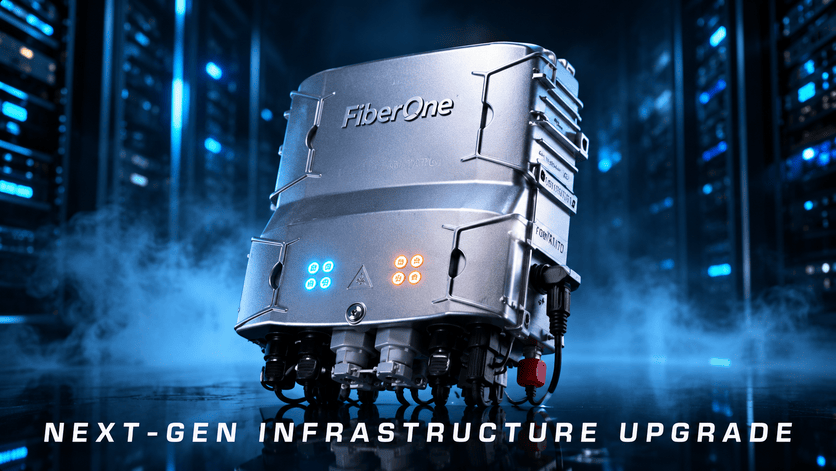
What FiberOne’s Next-Gen Infrastructure Upgrade Actually Does for You
FiberOne has completed a wave of its infrastructure upgrade from legacy network to next-generation XGS-PON (10-Gigabit Symmetrical Passive Optical Network) fiber technology. The upgraded network is already live in some Lagos locations, with more locations being migrated progressively.
No router swap. No technician visit to your home. No delayed service disruption. The upgrade happened on the network side, and you’re already experiencing the results.
Here is everything the next-gen infrastructure upgrade delivers, organised around three things every FiberOne customer actually cares about.
Faster Installs and Improved Speeds
The jump from our legacy (old) infrastructure to a next-generation fiber technology is not a minor network refresh. It is a generational leap in fiber technology, and its most immediate impact is on how fast your connection is set up and how fast it performs from the moment it’s live.
Equal 10 Gbps Upload and Download Speeds
The legacy infrastructure was built asymmetrically: download speeds were prioritised, while upload bandwidth was significantly restricted. That design made sense when most users only consumed content. Today, that model no longer fits how Nigeria works.
FiberOne’s next-gen fiber technology upgrade delivers true symmetrical 10 Gbps speeds, meaning upload and download performance are equally fast. For a remote worker on a Zoom call while screen-sharing a presentation, both directions of the connection hold their quality. For a content creator uploading a finished video to YouTube or TikTok, uploads that once took hours now complete in minutes. For a business running real-time cloud sync or backing up data to remote servers, symmetrical speeds mean operations keep pace without throttling in either direction.
High Density and Better Coverage
A single XGS-PON fiber strand can support 128 or more connections simultaneously, without any degradation in speed per subscriber. On the legacy infrastructure network, as more households connected within a shared fiber segment, everyone felt the slowdown. Peak hours were the worst time to be online.
With our next-gen upgrade, FiberOne can serve denser residential areas, including high-rise apartments, estate clusters, and high-footprint streets, without splitting speed across subscribers. The infrastructure also allows progressive expansion into new coverage areas using less physical cables, which means faster rollout to more locations over time.
More subscribers. Same fast speeds. No trade-off.
Faster Installation, Stable from Day One
The legacy infrastructure setup required on-site cable splicing during installation – a manual, time-intensive process that extended setup windows and introduced early instability in new connections. Our next-gen infrastructure eliminates that step entirely.
New FiberOne connections on the next-gen network are faster to complete and more stable from the moment they go live. The pre-terminated connectors used in next-gen deployments are cleaner and more precise than spliced joints, which means setup is shorter, connections are stronger, and you start at full speed from day one, not after a settling-in period.
Faster setup. Full speed from the first day.
Less Downtime and More Stable Connection
Speed means very little if your connection drops. Stability is the foundation everything else is built on, and it is where our fiber technology upgrade delivers some of its most meaningful improvements for everyday FiberOne users.
Resilient to Power Outages
On most broadband networks, a power outage on the distribution side means an internet outage at home, even if your home still has backup power running. The network infrastructure between the ISP’s hub and your home needs electricity to function.
This upgrade infrastructure is different. Its architecture is entirely passive between FiberOne’s central hub and your home, meaning those distribution lines require zero electricity to operate. The network itself does not depend on the national grid or any local power source in between. As long as your home has power from a generator, inverter, or any other backup source, your FiberOne connection stays live.
Grid power can fail. Your internet keeps running.
Seamless Multi-Device Support
The modern Nigerian home is running more connected devices than ever before – laptops for remote work, smart TVs streaming 4K content, phones on social media, gaming consoles, home security cameras, smart speakers, and tablets, all competing for bandwidth at the same time. The old infrastructure was not designed for this level of concurrent demand.
Our next-gen fiber technology handles it without compromise. Because the network supports a far higher density of simultaneous connections without speed degradation, every device in your home gets the bandwidth it needs, at the same time. Your work call doesn’t stutter because the kids are streaming. No one in the household gets throttled so someone else can be productive. Peak hours feel like off-peak hours.
Every device. Full speed. All at once.
Resilient to Power Outages
Speed and latency are not the same thing. You can have a fast connection that still produces choppy video calls, lagging games, or slow-loading pages, because those experiences are driven by how quickly data packets travel back and forth, not just how much bandwidth is available.
FiberOne’s fiber technology upgrade incorporates advanced Forward Error Correction (FEC) technology, which significantly reduces communication lag across the network. In practical terms: your video call with a client or colleague holds its quality without freezing. Your gaming session stays responsive and competitive. Your team’s collaboration tools: Google Workspace, Slack, Microsoft Teams, feel instant. And even when you’re connecting to servers overseas, the reduced latency makes those interactions feel local.
Low latency is what turns a fast connection into a smooth one.
Enhanced End-to-End Data Security
Stability also means security. Every interaction on your FiberOne connection – banking transactions, business communications, personal data, cloud uploads – travels across a shared fiber network. On the legacy infrastructure infrastructure, security protocols were limited.
Our upgrade has enhanced physical data encryption, robust authentication protocols, and built-in message integrity checks at the protocol level. This means your personal and enterprise data is protected across the network, not just at the device level. A more secure network is a more reliable one: fewer vulnerabilities means fewer disruptions caused by interference or interception.
A more secure network is a more stable one.
Easier and Faster Fixes
Even the most advanced network occasionally needs maintenance. What separates a great ISP from an average one is not whether issues happen – it is how fast and how simply those issues get resolved. FiberOne’s next-gen infrastructure is designed for faster, cleaner resolution at every level.
Instant Cable Swaps – No Long Waits
On the legacy infrastructure network, a fault in the physical cable often required complex on-site repairs – re-splicing, reconfiguration, and extended wait times before service was restored. The nature of spliced fiber joints meant that repairs were delicate and time-consuming.
Our fiber technology upgrade uses pre-terminated, plug-and-play fiber connectors. When something goes wrong at the cable level, FiberOne technicians can swap a faulty cable immediately – the same way you would replace a cable at home – rather than waiting for a splice repair. What used to be a multi-hour or multi-day resolution is now a fast, straightforward fix.
Simpler infrastructure means faster fixes for you.
Lower Operating Costs Mean More Stable Long-Term Pricing
This next-gen upgrade consumes significantly less power relative to its bandwidth capacity compared to legacy infrastructure. It also eliminates the complex field electronics that older networks required between the hub and your home. For FiberOne, this structural efficiency directly reduces operational costs.
For you as a customer, that matters because it creates the conditions for more stable, competitive subscription pricing over time. When the infrastructure is efficient to run and maintain, the savings are not absorbed entirely as margin – they translate into a sustainable service model that can grow without cost escalation being passed to subscribers.
Efficient infrastructure keeps your subscription costs stable.
Already Live. Already Yours.
FiberOne’s infrastructure upgrade is not a roadmap item. It is already active in some locations, and the rollout continues progressively across all coverage cities. Because the next-gen infrastructure operates on different optical wavelengths from the legacy, the migration happens over existing fiber paths with no disruption to surrounding areas or active connections.
Customers in upcoming migration areas will be notified when their location goes live.
If your connection has been running better – now you know exactly why.
Ready to experience the difference?
Check if FiberOne fiber is available in your area – and get the internet your home or business deserves.